



Rotel returns to loudspeakers, 25 years later. At €999, is the Amora 5 just testing the waters, or the first fruit of a future complete speaker range?
Amora is Portuguese for blackberry. In Portugal, they grow wild on brambles and picking them was one of my favourite childhood pastimes. I still enjoy them stirred into my morning yoghurt, though these days they come neatly packaged from the supermarket. The pleasure of picking my own has gone. Instead, I now pick out the notes from these Amora 5s.
Perhaps the name owes more to the Latin amor. That would work too: there is no shortage of love for music in this story. As for the 5, it leaves room for a whole family to follow. For now, though, that possibility is merely suggested by the name, and not claimed by Rotel.
These days, plenty of brands can commission a pair of speakers from China and put their badge on them. Rotel, however, has a reputation to uphold. Peter Kao, the third generation of the founding family, credits the company’s success to engineering excellence, lasting relationships and a passion for music. The Amoras have a heritage to live up to.
Rotel can now offer a system that runs from source to speakers. The Amora 5 does not, however, demand fidelity to the company’s amplifiers. Rotel itself admits it can be used with other audio equipment, which I did.
I began with the NAD M33 V2. It struck me as overkill for such small speakers, especially given the price. The Amoras sounded fast and dynamic, but a little dry for my taste. I preferred my LAB12 Mighty valve amplifier in triode mode. For relaxed listening — and relaxing into the music — I never felt short of power.
Inside the Amora
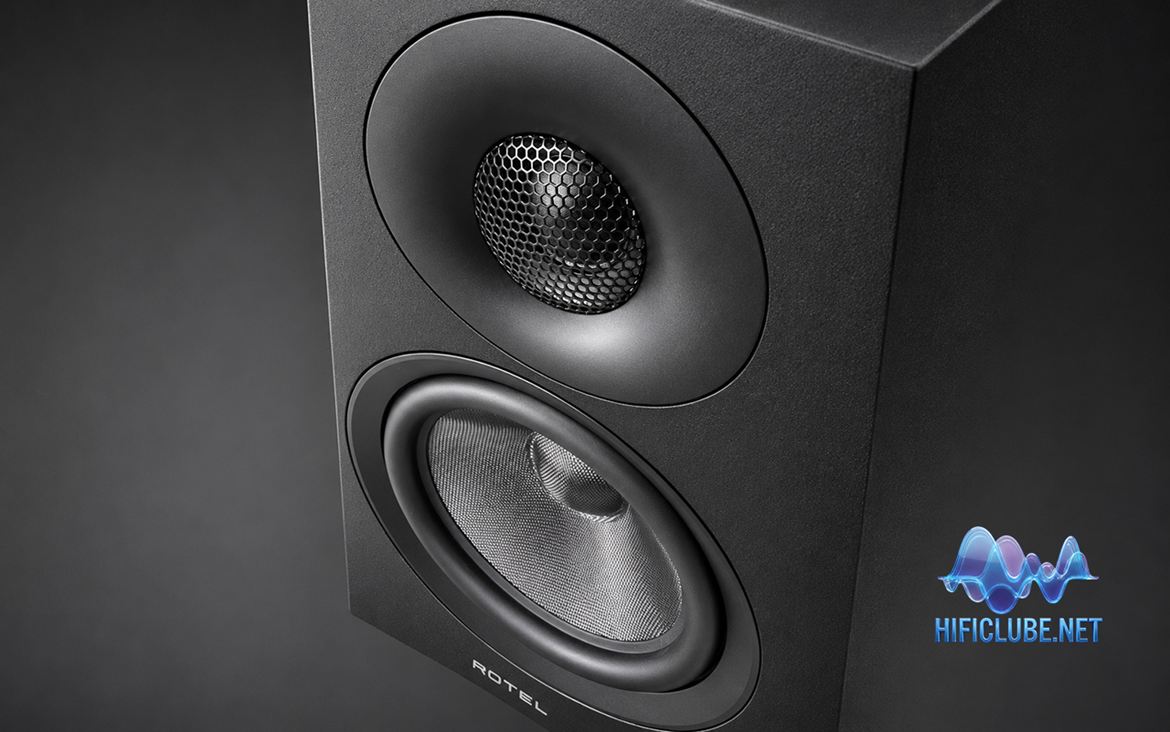
The Amora 5 is a two-way design, pairing a 25 mm silk-dome tweeter with a 165 mm mid/bass driver. The latter features a woven-fibre composite cone, though Rotel does not specify its composition.
The company describes the crossover as carefully tuned but gives no details of its slopes or components, only the crossover frequency: 2.5 kHz. The MDF cabinet is internally braced to control resonances and comes in matt black or white.
Behind its small protective grille, the tweeter features an aluminium mounting ring and a shaped ABS faceplate designed to minimise diffraction and improve dispersion. The mid/bass driver uses an aluminium chassis to ensure mechanical stability.
The bass-reflex port fires to the rear. Claimed frequency response is 48 Hz–28 kHz, with no tolerance stated. Two pairs of gold-finished binding posts allow conventional single-wiring or bi-wiring.
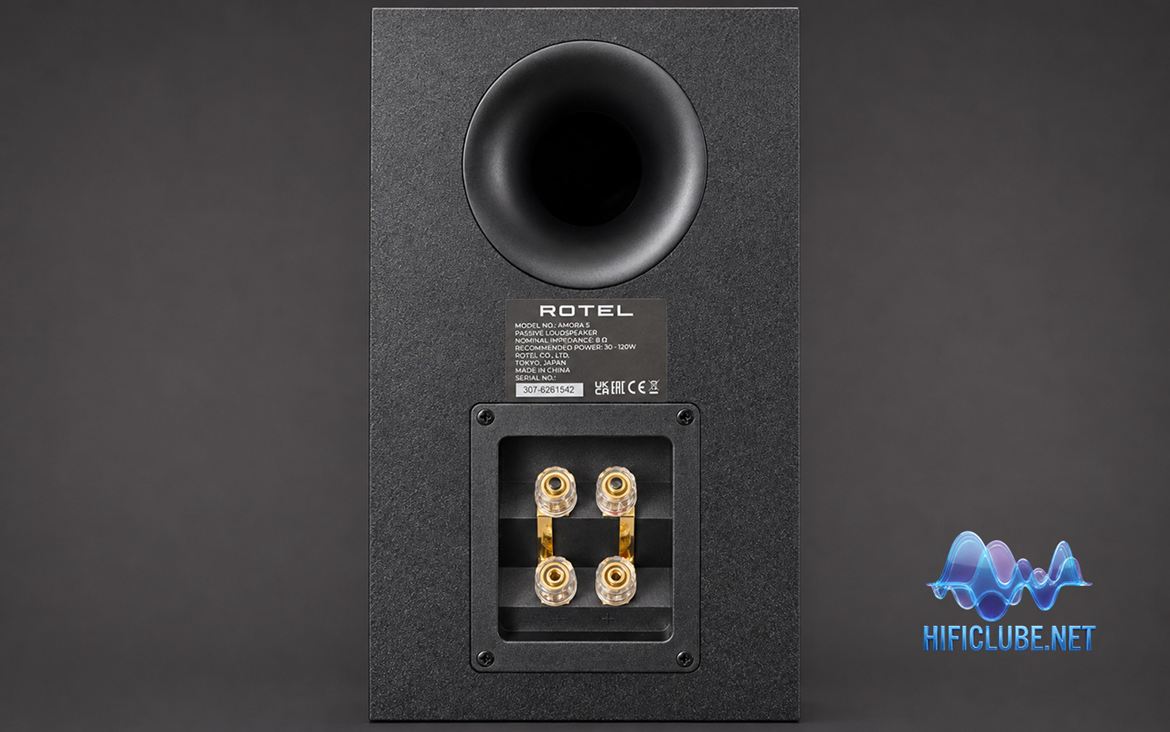
The bass-reflex port fires to the rear. Claimed frequency response is 48 Hz–28 kHz, with no tolerance stated. Two pairs of gold-finished binding posts allow conventional single-wiring or bi-wiring.
Sensitivity is rated at 87 dB (2.83 V at 1 m), with a nominal impedance of 8 ohms. Rotel recommends amplifiers delivering between 30 and 120 watts. These are useful guidelines, although the nominal 8-ohm figure doesn't tell us exactly what load the amplifier will face in practice.
The fabric grille attaches magnetically, leaving no fixing holes visible on the baffle when removed. Rotel describes it as acoustically transparent. I left the grilles off for listening, transparent or not.
At 35 cm tall, 19 cm wide and 30 cm deep, and weighing 7.7 kg each, the Amora 5 strikes me primarily as a standmount. I would start with the rear panels 30–50 cm from the wall, then adjust the distance to get the bass right. The room also has a say.
A taste of music
The first impression is of a clean, resolving sound. The tonal balance leans toward the dry side, with a well-defined midrange and silky treble, appropriately, given the dome material, that never becomes as impertinent as that of some metal tweeters.
I usually begin listening to small stand mounts with Blues Company’s ‘Dark Day’: a suitably bluesy male vocal and a bass line with plenty of swing. Then comes Boz Scaggs ‘Thanks to You’, to find out how far down the bass will go.
The Amora 5s will not rattle the windows or the glasses in the cabinet. But they can convey the musicians’ passion.
In “Thanks to You”, they draw the listener into a declaration of love that has restored the singer’s sense of purpose and emotional security. There is more to music than just bass extension.
They also do justice to the fine musicianship on Diane Schuur’s “New York State of Mind”: the interplay between bass and drums and, of course, Stan Getz on saxophone. I missed nothing except the scale that full-range speakers can provide. You can’t have it all.