


Streamer, DAC, preamplifier, CD player and ripper, room-correction system, and network music server. All for €2,590. Eversolo continues to focus on versatility at affordable prices.
When I reviewed the first DMP-A8, I wrote that Eversolo had found the easiest path to sales success: versatility and a competitive price. However, many brands still pretend not to know that more functions in a single chassis don't always mean a compromise in sound quality.
This second generation goes even further, bringing the CD back into the spotlight. The lovely Eki Shaw presented the A8 Gen 2 to us at High End 2026 in Vienna, alongside nearly a dozen new products, including the Master (see the video).
The DMP-A8 Gen 2 and the Master version share much of the same architecture. The Master adds a CD player, a more sophisticated clock system, and greater attention to galvanic isolation. Which one you choose depends on how you plan to use it and how ambitious your system is.
A Striking Design
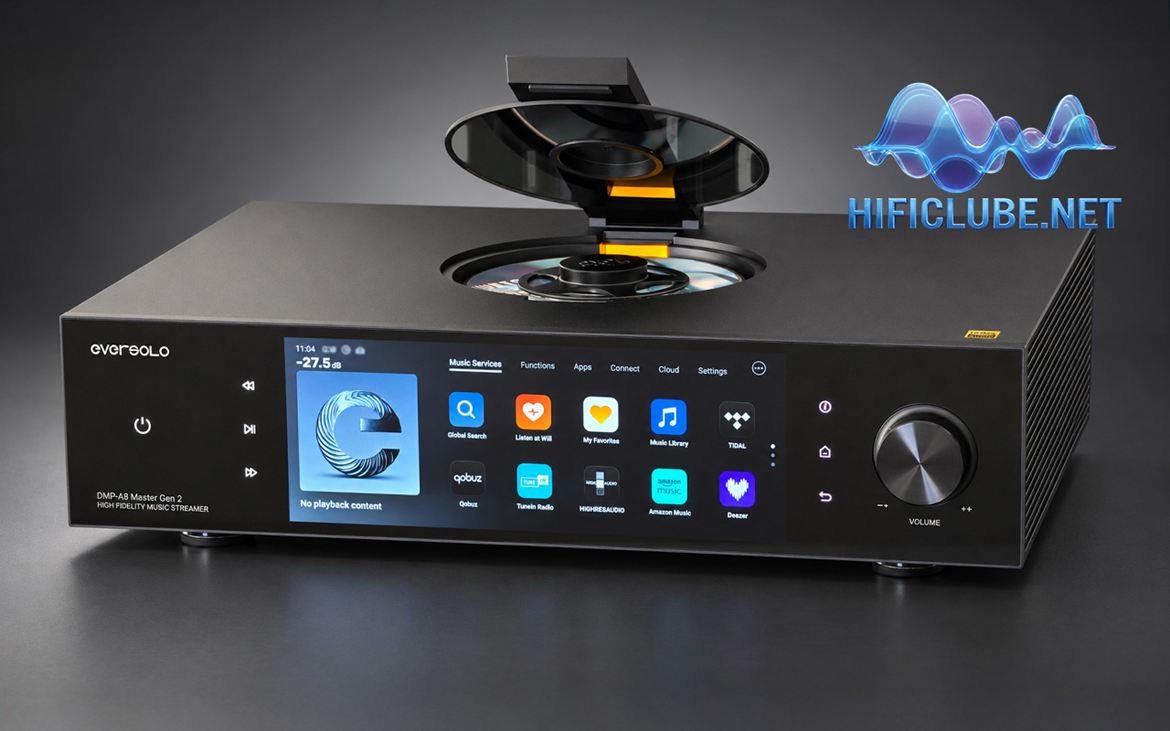
At first glance, the new A8 appears only slightly larger than the original and features an extraordinary 8.6-inch touchscreen, which, in the Master version under review here, is complemented by a top-loading CD player. Eversolo is targeting what may well be the last remaining segment of the streamer market: the perfect digital machine that hasn't forgotten analog.
The chassis measures 388 × 265 × 98.5 mm, weighs around 6 kg, and retains the machined aluminum finish we've come to expect from Eversolo. The front panel is dominated by the screen, a spectacle of light, color, and functionality. But it would be unfair to reduce it to a pretty face.
The Master, kindly sent to us by the distributor Delaudio, is a streamer, DAC, analog preamplifier, music server, CD player, ripper (for copying CDs), digital processor, room-correction system, and digital transport. Phew! Personally, I'd like the CD transport to support SACD discs as well, and the preamp to have a headphone output, like the DAC-Z10.
For those of us who have kept our CD collections, it's like riding a bike again. You never forget.
With the A8 Master, we rediscover the pleasure of listening to an album in its original release, without an algorithm choosing alternative versions for us.
The Return of the Ritual
The top-loading design restores the pleasure of lifting the lid and placing the stabilizer on the disc — a ritual reminiscent of vinyl turntables, which streaming has deprived us of.
For those of us who, like me, have kept our CD collections, it's like riding a bike again. You never forget. As with the LP, the announcement of the CD's demise seems somewhat exaggerated.
After twenty years of ripping CDs to hard drives to get rid of them, Eversolo has unveiled a machine that forces us to go up to the attic and fetch the dusty boxes of CDs stored for years as useless relics of the past. There I found editions that don't exist on streaming platforms and others that have since been replaced by remasters of dubious editorial quality — just ask Delfin Yanez!
With the A8 Master, we rediscover the pleasure of listening to an album in its original release, without an algorithm choosing alternative versions for us. Not that this bothers me all that much: if I could, I'd even have a Tesla Optimus robot load the discs into the transport so I wouldn't have to stand up.
Please note: the CD transport's transparent circular lid needs some clearance to open. Bear this in mind, as you'll need to place the Master on the top shelf, where it will look great. It's a really smart device.
Pierre Verany Test Disc
Eversolo presents the Master as a bespoke solution, offering stable playback and quiet operation. Eversolo also claims that the Master's transport features a robust error-correction system.
I put this to the test with the Pierre Verany test disc, and indeed it coped well with simulated defects up to 1 mm. A respectable result, though by no means a world record.
Some early CDs were recorded with pre-emphasis and require the de-emphasis curve to be applied during playback; without it, they can sound unnaturally bright. The Master's documentation doesn't clarify whether it applies this correction automatically. I think not. But really? Only someone who's been in this business for more than 40 years would bring this up.
The transport also lets us rip CDs to digital files, retrieving cover art and metadata. Duplicate detection helps organize the library. Disc, file, or streaming: everything is controlled by the same application. If that isn't redefining the concept of 'all-in-one'…
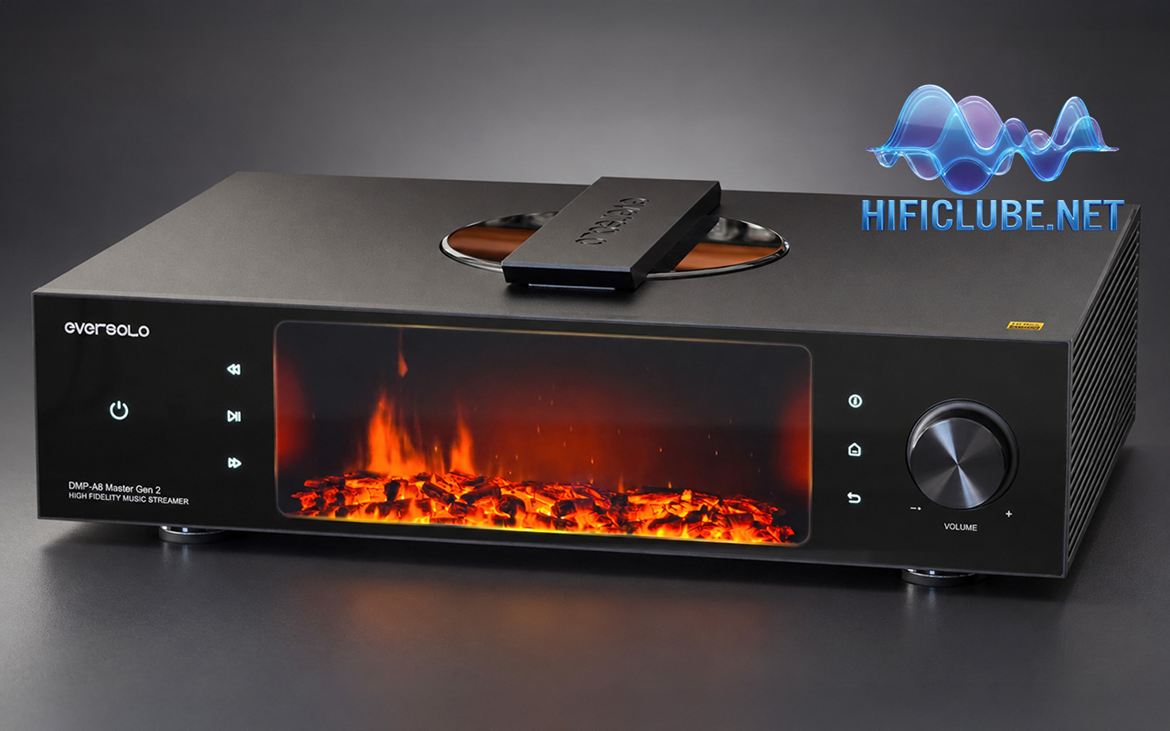
If the user doesn't like it, they can switch it off. But I bet they'll show off the fireplace to their friends…
Interactive Library
The screen makes it easy to browse the library, select tracks, and view settings. The VU meters and spectrum analyzer are for those who like to 'see' the music as it plays. I have my days.
But I'll admit that a display showing an animated fireplace or a starry sky is as kitschy as it is reassuring. Eversolo must have thought: if we have the technical capability to do it, why not? If the user doesn't like it, they can switch it off. But I bet they'll show off the fireplace to their friends…
Under the hood, it has an eight-core processor, 8 GB of RAM, and 64 GB of internal storage, making navigation particularly fast. For music storage, it includes a slot for an M.2 NVMe SSD up to 8 TB (not included), which you can install without dismantling the device, plus access to external storage via USB and networked libraries.
But don’t judge a music library by the number of tracks; judge it by its ability to find the right version, browse by artist or composer, and switch from local files to streaming with a single command. In this case, the software matters more than the hardware.
AKM: A Winning Combination
The conversion stage retains the combination of the AK4191EQ processor and the AK4499EXEQ DAC. The former handles digital processing, while the latter performs the D/A conversion. The aim is to reduce digital interference in the analog section, which is more sensitive to noise.
The system uses AKM's Velvet Sound architecture and supports PCM up to 768 kHz/32-bit and DSD512 (22.59Mhz), depending on the input or output used. I've confirmed this. These are merely compatibility limits: the optical and coaxial inputs don't support the same high sampling rates as the USB input.
The MQA Mystery
The Eversolo DMP-A8 Master Gen 2 plays MQA-encoded FLAC files, but it doesn't perform the MQA unfold, retaining the original sample rate rather than expanding it. In other words, it plays the FLAC audio but apparently does not decode the embedded MQA information.
Note: I tested dozens of MQA-encoded FLAC files associated with recordings at sampling rates ranging from 44.1 to 192 kHz. The Eversolo DMP-A8 Master Gen 2 played them normally, but showed no indication of MQA decoding. Files at 44.1 kHz were played without the first unfold to 88.2 kHz.
Note: Eversolo informs that, since Tidal no longer supports MQA, MQA will not be available on our new models.
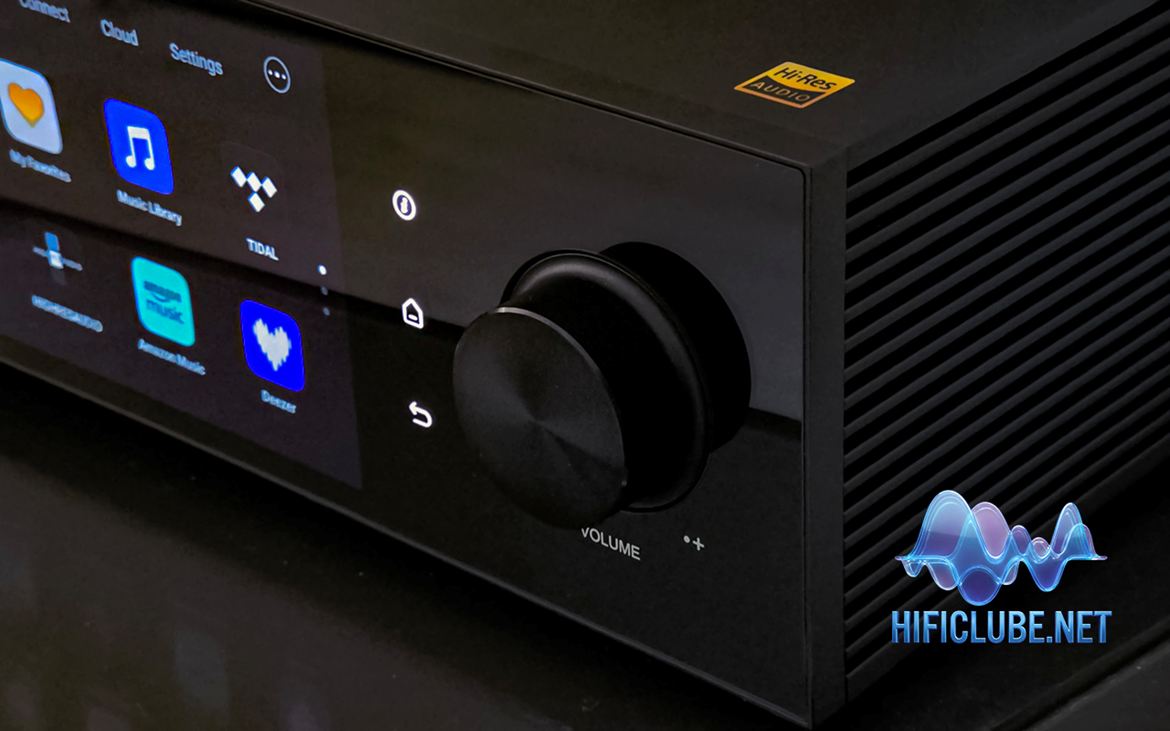
Some people don't like the ticking sound. I do. It provides a physical sensation that digital controls lack.
Up and Down the Stairs
The balanced analog preamplifier uses an R-2R resistor ladder to control volume rather than reducing the level in the digital domain. Some people don't like the ticking sound. I do. It provides a physical sensation that digital controls lack. You may avoid the long path by selecting 2 dB instead of 0.5 dB steps.
The RCA and XLR inputs accept analog sources without digitizing them. However, the DSP functions are intended for digital sources and do not process analog inputs. The outputs allow you to drive a power amplifier or active speakers. The digital outputs also support an external DAC, which you really don't need.
The Mastering of Time
The OCXO clock keeps the crystal at a controlled temperature to improve frequency stability. Eversolo claims clock jitter of less than 50 femtoseconds (!) and includes a PLL circuit for additional stabilization.
These specifications are typically associated with much more expensive high-end audio equipment, though the figures alone don't determine the audible performance of the complete system. When I listen, I hear no jitter or distortion. To my ears, the Master is completely transparent. All independent measurements confirm this. That said, the slightly warm tonal balance I mention must be subjective, perhaps just a matter of taste, not a contradiction.
The Master also has a 10 MHz/50-ohm external clock input, which I haven't tested. It looks as if Delfin Yanez commissioned it specifically to accommodate the 'atomic' clock from Vasco Soares, which he always uses to listen to CDs.
Delfin Yanez is the most time-sensitive audiophile I know — not in terms of the weather, but in terms of the temporal precision of D/A conversion.
Here, along with the CD transport, the Master begins to justify the price difference. The standard A8 Gen 2 uses the same AKM combination, display, processing platform, and preamplifier at a much more affordable price (€1,990).
When I listen to the Master, I get a sense of total absence of jitter and distortion. To my ears, the Master is completely transparent. All measurements only confirm it.
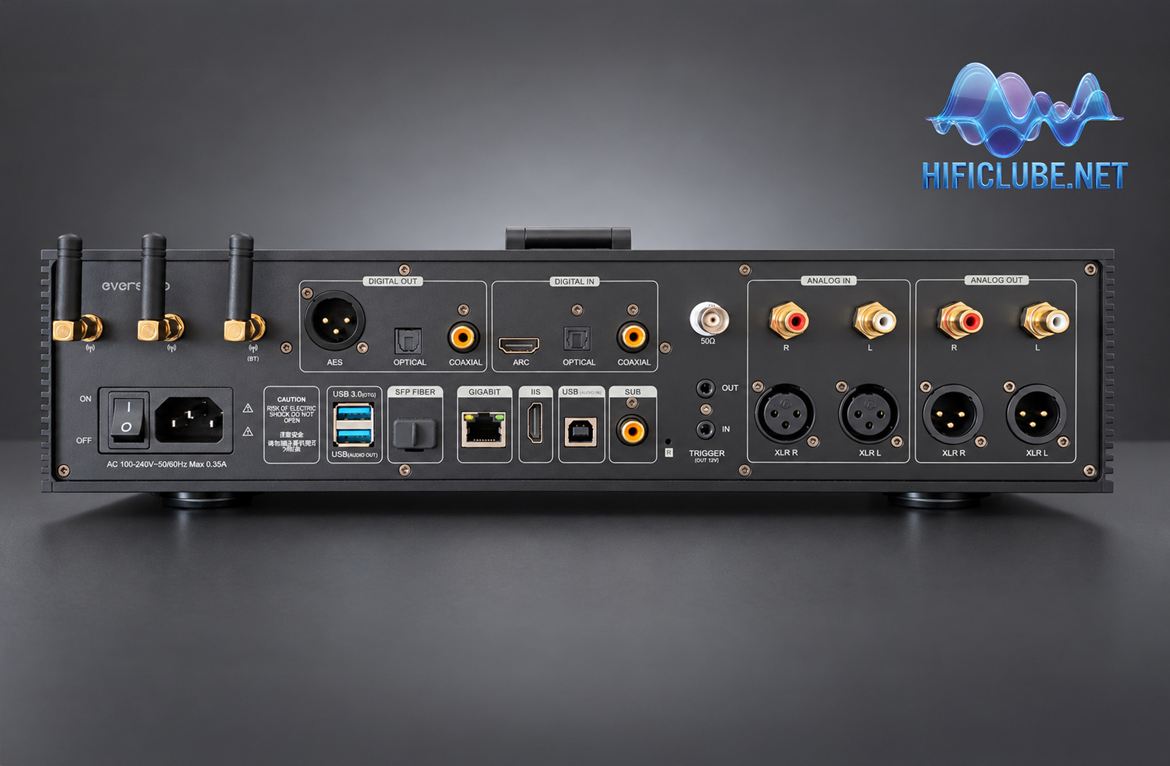
Connections include Ethernet, Wi-Fi 6, and an SFP interface for fiber-optic networking, with the module sold separately.
Network, TV and Living Room
Connections include Ethernet, Wi-Fi 6, and an SFP interface for fiber-optic networking, with the module sold separately.
I do not consider the latter a must-have until proven otherwise. However, I already use a SilentPower optical network converter, although the arrangement isn't exactly equivalent to a direct SFP connection.
The HDMI ARC/eARC input receives audio from a television, but you must select it manually. The subwoofer output makes it easy to set up a 2.1 system. For many readers, these features will be far more useful than, for example, the external clock input.
The evotune PRO system performs room correction using FIR filters and adjustable target curves, based on measurements from a USB microphone or a smartphone's microphone. For greater accuracy, Eversolo recommends a dedicated USB measurement microphone.
It also offers 20-band parametric equalization, loudness control, dynamic compression, and FIR filter import. These tools are useful, especially for correcting the bass, but the outcome depends heavily on the measurements and the correction applied. The DSP operates on compatible digital sources; according to the manual, PCM above 192 kHz and DSD bypass this processing. But I use room correction only as a last resort when the room and speakers are hopelessly incompatible.
The Android-based platform uses Eversolo's proprietary EOS (Eversolo Original Sampling-rate Audio Engine) to bypass the operating system's automatic sample-rate conversion (SRC), enabling bit-perfect playback in compatible applications, provided no digital processing is applied.
It integrates TIDAL, Qobuz, Apple Music, Amazon Music, Deezer, HIGHRESAUDIO, Spotify, and other services, alongside TIDAL Connect, Qobuz Connect, Spotify Connect Lossless, DLNA/UPnP, and NAS access via SMB, NFS, or WebDAV. It's also compatible with Roon and Audirvāna, the latter via DLNA/UPnP.
Do not confuse digital correction with bit-perfect playback: altering the frequency response, level, or sampling rate in the digital domain changes the data, so playback is no longer bit-perfect. Some people prefer bit-perfect playback to upsampling. I've listened to many CDs upsampled to 705.6 kHz, and I liked what I heard.
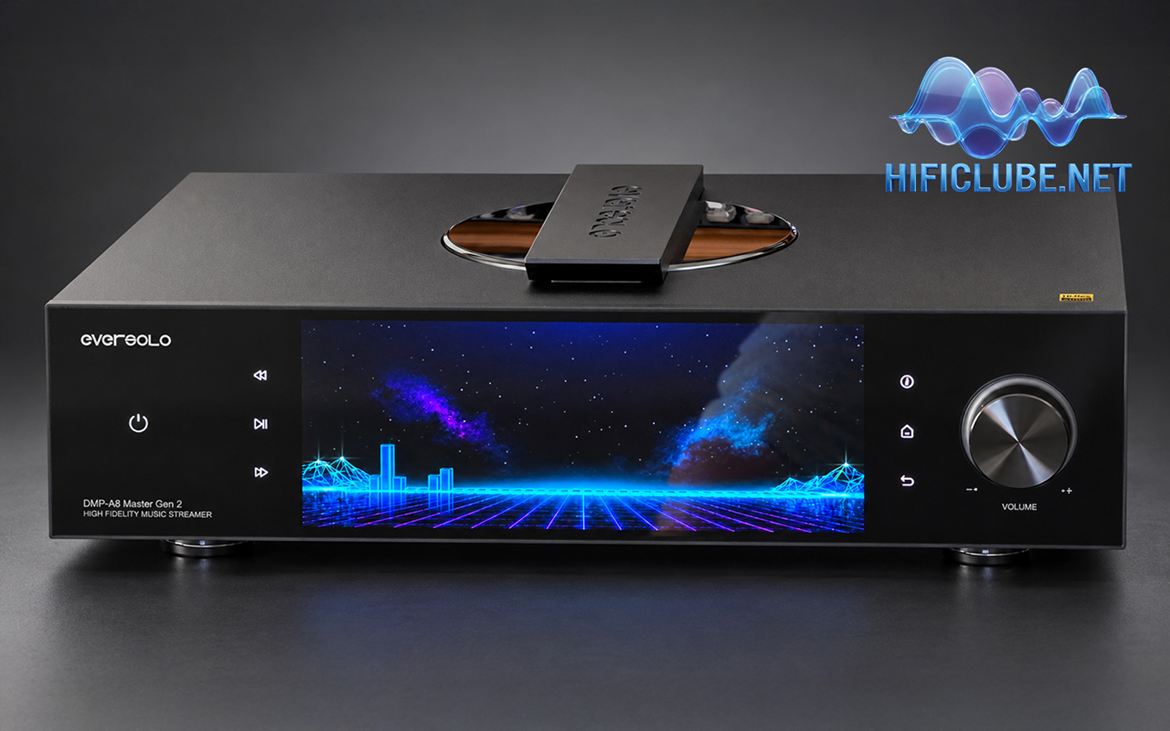
A display showing an animated fireplace or a starry sky is as kitschy as it is reassuring.
Bit-Perfect or Upsampling?
While listening to Jennifer Warnes' Somewhere, Somebody on TIDAL, the Master correctly identified the source: FLAC — 44.1 kHz — 16-bit. But further down, the screen showed PCM 705.6 kHz: exactly 44.1 multiplied by 16. I checked the menu: Upsampling: Original/Off; DSP: Off. I went back to the home screen: still 705.6 kHz.
I even suspected the Master was upsampling against my will: 'Oh, you've selected Original, so you're going to hear this at 16× because I know what's best for you.'
As it turned out, the explanation was simple: the upsampling selector does not take effect on the fly. In other words, when switching from 16× to Original during playback, the previous processing remains in effect until you re-cue the same track or select another one. Only then did the displayed output return to 44.1 kHz. Anyone who thinks they're comparing two different settings may be listening to the same one without realizing it.
But do give it a go: Original, 2×, 4×, 8×, and 16×. Starting from 44.1 kHz, we reach 88.2, 176.4, 352.8, and 705.6 kHz; in the 48 kHz family, the limit is 768 kHz.
Upsampling does not recover information that was never recorded. It changes the conditions under which digital and analog reconstruction filtering take place.
At higher sampling frequencies, a slow roll-off filter can offer a different trade-off among frequency response, suppression of ultrasonic artifacts, and pre-ringing. As the sampling rate increases, the gentler filter roll-off moves further from the audible range. This does not eliminate the quantization noise from the original recording, nor does it guarantee better sound. But it does help. A lot.
Have you ever seen Chinese soldiers marching in presidential parades? That is how Eversolo seems to train its bits, with no deviations in time or space. All aligned.
Marching Bits
The sound presentation combines extreme fluidity with high resolution, featuring an almost military organization of space.
Have you ever seen Chinese soldiers marching in presidential parades? That is how Eversolo seems to train its bits, with no deviations in time or space. All aligned.
The DAC-Z10, for example, sounds more neutral to me, while the A8 Master subtly leans toward the warmer side of neutrality. Vocals may sound less explicit, I admit, but they possess greater human warmth. The natural decay of instruments seems to linger ad infinitum. I enjoyed listening to high-resolution files more than CDs, even when the CDs were upsampled. This sonic character lets you follow the recording's detail without it intruding on the musical flow. Do not mistake excess bass for body or treble emphasis for transparency. The soundstage, however, depends largely on the relationships between scale, distance, and intensity. Just ask Delfin.
'Velvet Sound' refers to an AKM technology, not necessarily a sonic attribute. Eversolo is solely responsible for the final sonic character — not all DACs using Velvet Sound technology have this 'velvety' sound.
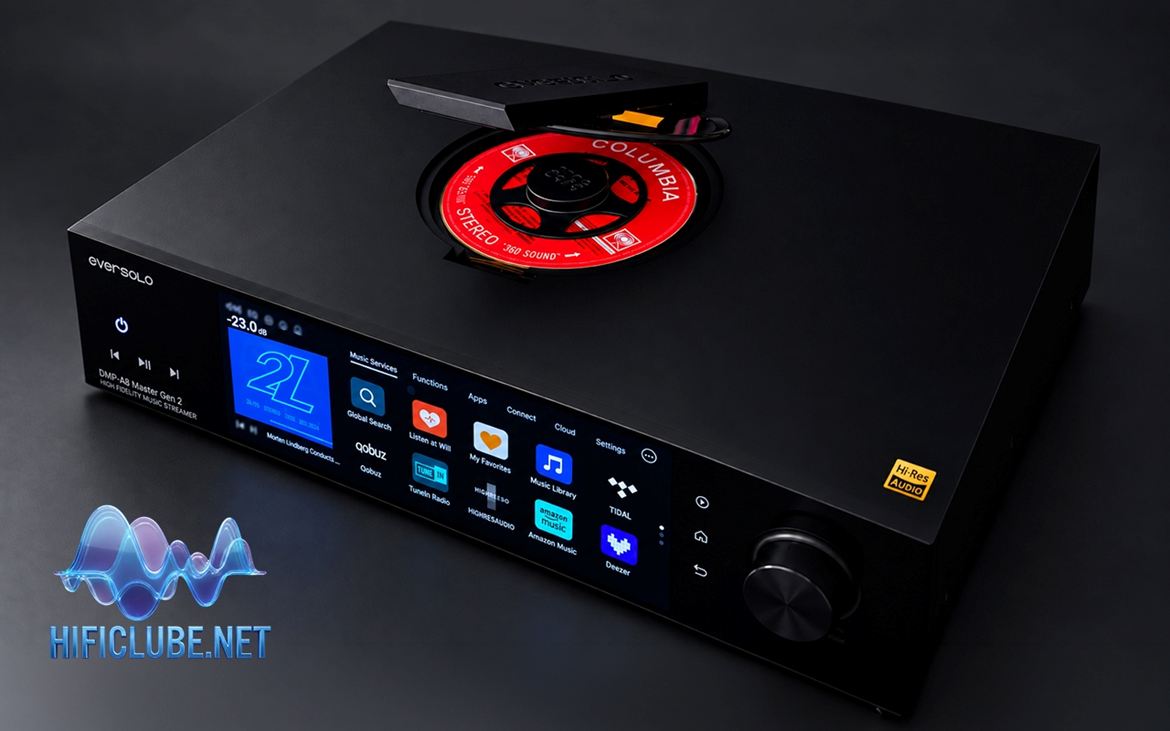
The Master's most compelling argument is integration.
Yes, Master!
The Master's most compelling argument is integration.
For those who stream but keep CDs, store thousands of files, and still rely on an analog source, the proposition makes sense. Anyone looking simply for a streamer should consider the conventional Gen 2.
Assess the features in the context of your system and budget, without letting the word 'Master' decide for you.
Eversolo continues to simplify our lives without limiting our choices. For many of us, myself included, the CD remains an important source of listening pleasure. It's a shame the transport isn't SACD-compatible, even though the Master can play SACD ISO files.
Absolutely recommended. Given this smart combination of features and price, I’m not at all surprised by its sales success. Even I became a follower of the Master.
For further information: DELAUDIO