




Ler o artigo em Português aqui.
The Phonitor X is an audiophile headphone amplifier designed and manufactured by SPL, a German brand that has been developing professional audio technology, cinema, multimedia, hi-fi, and broadcasting equipment for over 35 years.
The Chinese audio industry has significantly changed the global hi-fi paradigm. Gone are the days when China only produced cheap copies of European products. Today, China produces products that rival those of Europe – and even the United States – in terms of quality, all at affordable prices.
However, as in the automotive industry, where Chinese technology leads the way, the prestige of brands such as BYD still cannot compare to that of Porsche, for example. The status a major European brand confers on its owner continues to have a significant influence on purchasing decisions. European products are generally more expensive, but they also carry greater prestige, especially those from Germany, due to historical factors and the prevailing perception of industrial quality.
So, when Esotérico sent me the SPL Phonitor X headphone preamp and amplifier to test, which costs €2,549 (with optional DAC: +€450), the first temptation was to compare it with a cheaper Chinese product. In this context, SPL is, in European terms, a comparatively affordable German brand, unlike other brands such as Burmester, MBL or T+A, although the construction still reflects German quality. I would even dare to say: professional quality.
In fact, on the Esoteric website, you can read: SPL is a German brand that has been developing professional audio technology, cinema, multimedia, hi-fi, and broadcasting equipment for over 35 years.
It is therefore no surprise that the Phonitor X (preamplifier and headphone amplifier), reviewed here, is part of the Professional Fidelity Series, which also includes the Phonitor Xe (headphone amplifier), Phonitor se (headphone amplifier), Director Mk2 (DAC and preamplifier), Electro (analogue preamplifier), Diamond (DAC), and Phonos (phono preamplifier).
VOLTAiR 120V
All of them employ the exclusive VOLTAiR (120V) reference technology, which, according to SPL, and I quote from the catalogue:
- “It is unique in the world. It operates at a direct current (DC) voltage of 120 volts, which is four times that of semiconductor op-amps based on ICs. Note that the “120V” in the name of this technology has nothing to do with the mains voltage. It refers to the internal operating voltage with which the audio signals are processed.
- The mains voltage is transformed into the secondary voltage required in the internal linear power supply with a toroidal transformer. Rectifiers convert this alternating current (AC) voltage into the direct current (DC) voltage required by the audio device.
- 120V technology operates at ±60 V. To handle such a high voltage, we have developed unique operational amplifiers capable of operating at ±60 V DC: the SPL 120V SUPRA. A voltage of this level would destroy conventional components and common op-amps.
- 120V technology delivers exceptional technical specifications and audible advantages, including dynamic range, signal-to-noise ratio, and headroom, as well as richness of detail and a relaxing listening experience.
- SPL also states that, and I quote, “experiencing and listening to the original recordings and instruments is more important to SPL than following the rules”.
Well, it is up to us now to assess the full extent to which all this is actually true.
Listen To Music, Not Measurements
A general review of the extensive online information about the Phonitor X, including laboratory measurements, confirms that we are indeed dealing with a powerhouse capable of delivering 3.4 W into 120 ohms with only 0.0009% distortion. However, distortion increases at high frequencies when powering low-impedance, low-sensitivity planar magnetic headphones, i.e., the same type of headphones I used in the listening test.
Nonetheless, we are discussing a maximum distortion of 0.24% at 20 kHz, which is totally imperceptible to the human ear. Clearly, I didn't notice any distortion – just music, sometimes better recorded than at other times. That's all. In fact, this is merely academic. The distortion of the Phonitor X will always be far lower than that of any headphone model (or speaker, if used as a preamp).
SPL could have easily resolved the issue by increasing negative feedback, which might have influenced sound quality. However, listening to the original recordings and instruments seems to be more critical to SPL than following the ‘rules’, i.e., the dictates of audiophile scientism, which involves “listening to music” with measuring equipment instead of your ears.
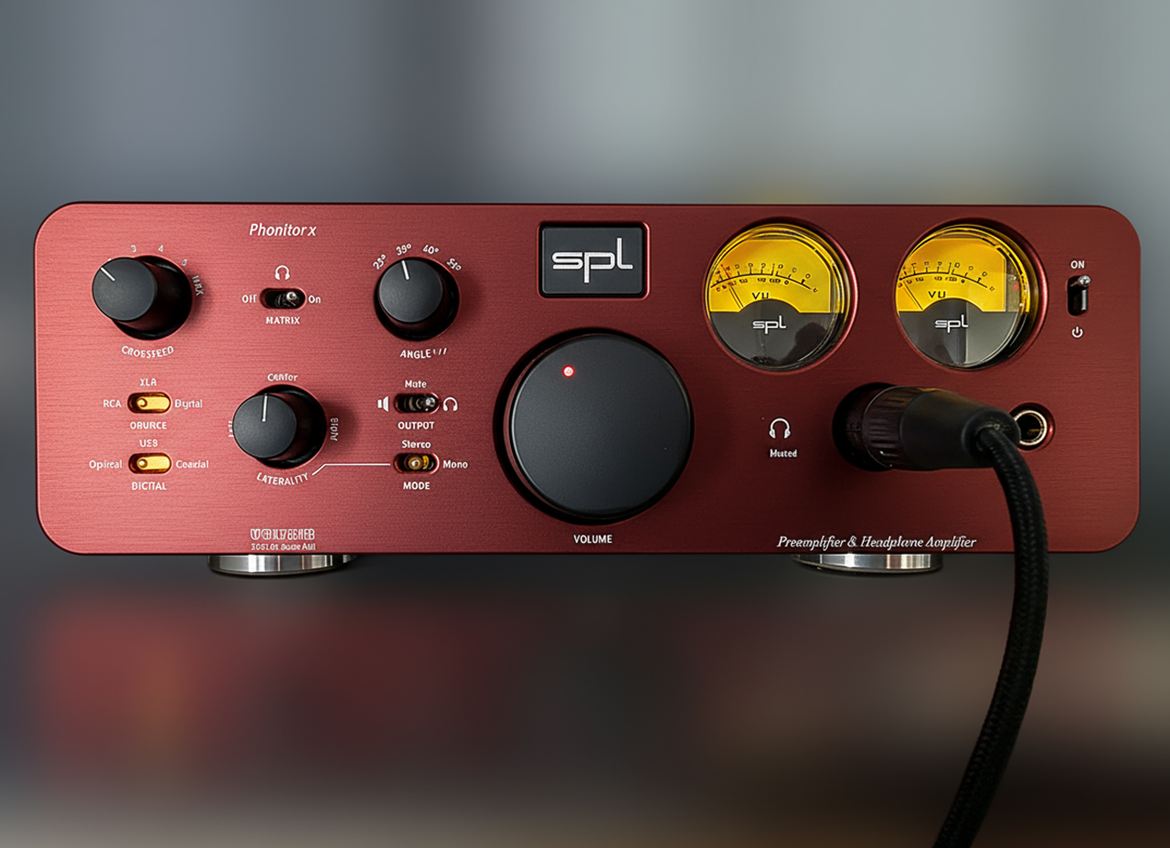
The Phonitor X dresses in flammant red.
From Black to Flammant Red
The Phonitor X is available in black, but you can also choose silver or flammant red, the most striking colour. The chassis is robust, and the aluminium front panel resembles an aircraft cockpit, with mechanical VU meters that display input rather than output voltage. These meters operate independently of the volume set by the large central rotary knob.
And we will soon realise how important this is because you might be listening to music at a very low volume and still watch the needles “hitting” the red. So, what if the needle goes into the red zone? Does it cause distortion, even when listening at a low volume? Not necessarily.
The “red zone” on the Phonitor X's VU serves as a reference warning (+4 dBu = 0 VU), rather than an indicator of instant clipping. The device can handle very high input levels (up to +32.5 dBu of internal headroom) due to its 120 V architecture, so quick peaks above 0 VU rarely cause audible saturation, especially with music.
However, in a laboratory setting, best practice suggests lowering the input source level on the DAC, in the digital transport (such as Roon), or by attenuating the VU sensitivity via a DIP switch (located underneath the device), so that the needle stays within the safe zone most of the time.
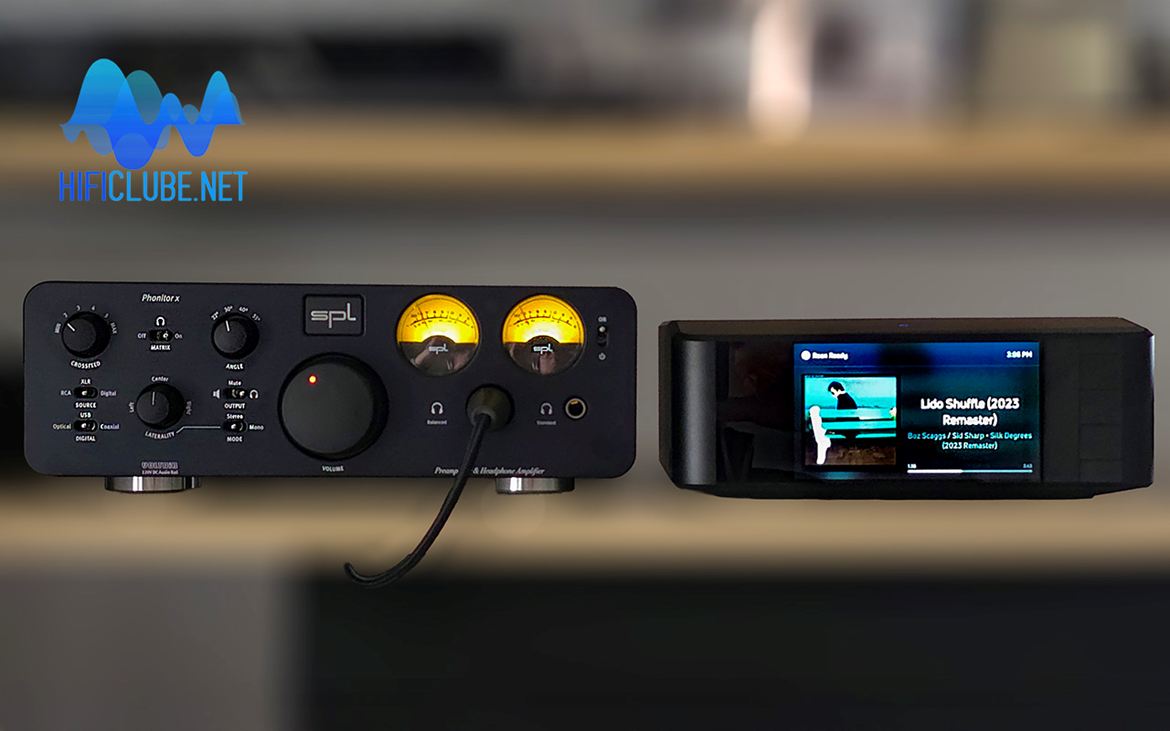
The ICON Node can be the perfect digital music source to feed the Phonitor X.
I used the Bluesound Node Icon as the source, as it allows easy adjusting of the output level. However, I preferred the sound with the Icon in digital passthrough mode (0 VU), so I lowered the level by 3 dB using Roon's parametric EQ instead.

Suggested EQ for Hifiman HE1000 headphones with the Roon platform
Crossfeed, Angle and Laterality
On the right, just below the VUs, are the headphone outputs: balanced (4-pin XLR) and single-ended (6.35 mm). The now fashionable 4.4 mm balanced Pentaconn is missing.
On the left you can find the EQ Matrix functions: Crossfeed and Angle, both controlled by small, satisfyingly tactile rotary knobs (it feels good to overcome the stepped rotation resistance).
The Crossfeed mode, which features six positions between MIN and MAX, is not new. It involves allowing some signal from the left channel to leak into the right, and vice versa, to create a ’stereo image' that more closely resembles what we experience when listening with speakers.
Angle mode is not so standard, though; it offers four positions between 22° and 55°, with the angle determined by the distance between the virtual speakers we aim to emulate in the headphones.
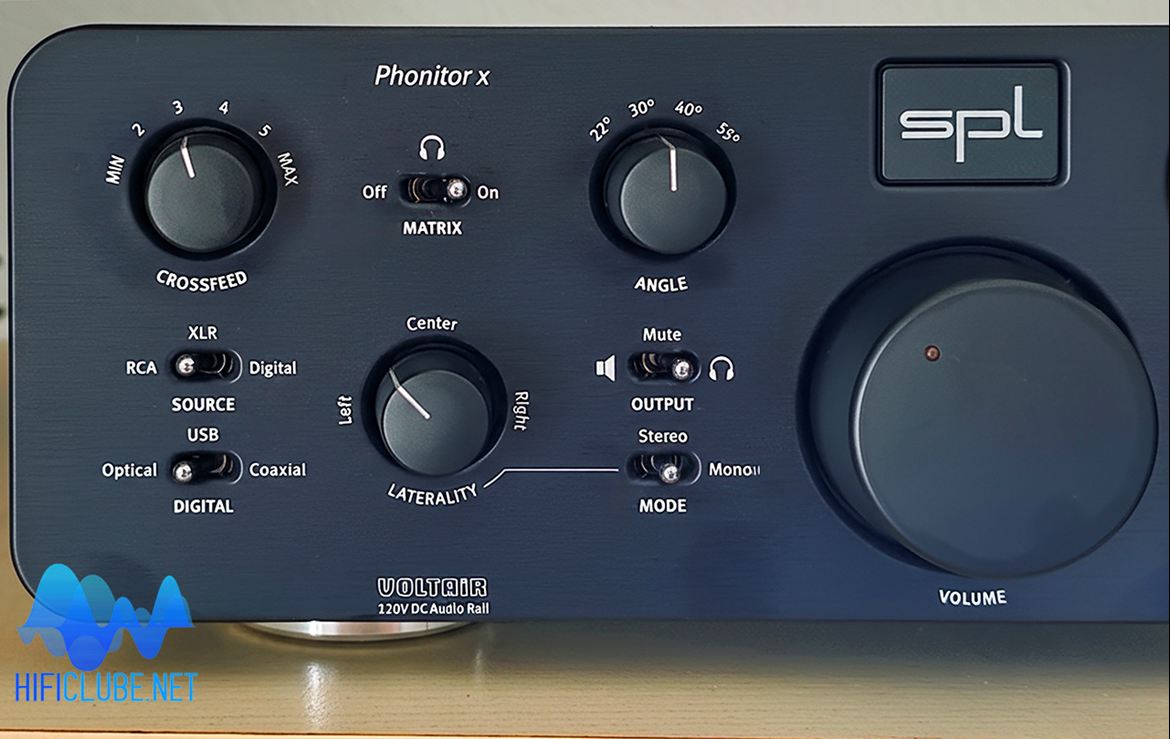
The SPL Phonitor X has some unique functions, such as Matrix and Laterality.
Does it work? Yes, if you don't overdo it (I opted for Crossfeed=2; Angle=30º), the acoustic effect will be very rewarding. And you can make an immediate A/B comparison by turning Matrix on and off.
The feeling of a more compact image (with a greater presence of the musicians) or a wider image (with more space for the musicians) is immediately apparent. The choice largely depends on the musical genre and the type of recording. It will be a party in the early days. Then the enthusiasm fades away, and we end up opting for the standard tuning or the one we like best and forget about it.
The third button adjusts what SPL calls ‘Laterality’. This mode allows for fine-tuning the balance between channels. By turning the conventional Balance knob, we can reduce the volume on either the left or right channel to centre the sound or pull all the sound to one side. With ‘Laterality,’ we can adjust the position of the vocalist, for instance, without significantly affecting the overall image. A quite intriguing effect.
It reminded me of a hilarious episode of ‘Seinfeld,’ whose title was ‘Serenity.’ That's right, I think “laterality” restores “serenity” to the music.
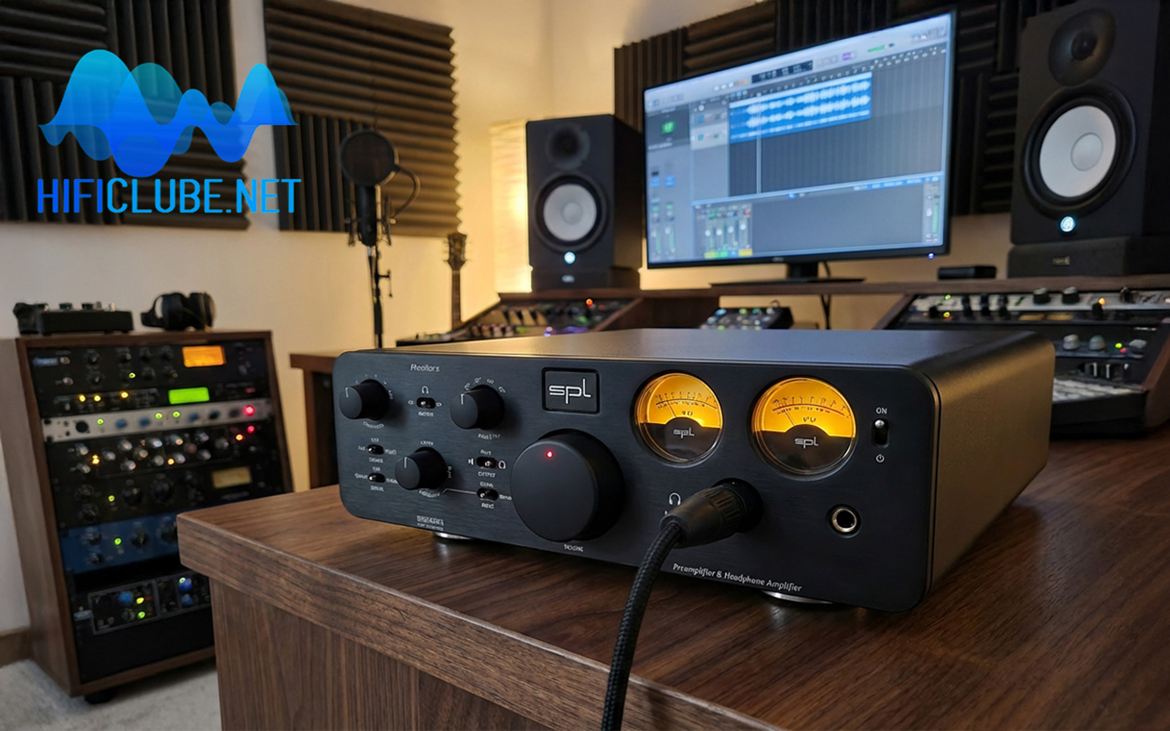
The pleasure of having professional studio equipment in your home environment.
DAC or no DAC? That is the question
Besides the Matrix toggle switch, there are four more controls of this type. Two analogue sources are supported: RCA/XLR, and digital options include Optical, USB, and Coaxial, if you have chosen the all-in-one version of the Phonitor X equipped with a DAC 768xs module.
The Phonitor X, kindly provided to us by Esotérico Consultores de Som, is the version without DAC. The module can be bought separately and easily installed.
But this Phonitor X is also an excellent preamplifier. Simply set the control to the speaker position, and you can connect to an external amplifier or active speakers (without Matrix, for use with headphones only).
Finally, you can select between ‘Stereo’ and ‘Mono’, the latter being particularly useful for positioning speakers correctly or for mixing music for monophonic speakers (such as portable speakers).

On the rear panel, there are RCA and XLR inputs (the same ones I used with the Icon), as well as RCA and XLR preamp outputs.
The Phonitor X's declared power is impressive: up to 3.7 W (1 kHz, 120 Ω), with similarly strong figures over 300 Ω and 600 Ω; and even 1 W at 32 Ω. For demanding headphones, there are DIP switches hidden under the chassis (what a weird idea!) that boost the headphone level (+12/+22/+24 dB), a feature many rivals do not offer.
I admit the numbers are somewhat optimistic, especially with 16- and 32-ohm loads, but I never felt a lack of power or macro dynamics, which, although not reference-level, are very convincing.
The Phonitor X treats music as material to be revealed, not material to be embellished.
The Phonitor X is a professional studio instrument that treats music as material to be revealed, not as material to be embellished. If you seek a harmonious romance with music, choose a valve amplifier. You gain in warmth what you sacrifice in dynamic brilliance.
Active Neutrality
The Phonitor X tells you straight to your face, or rather, directly to your ears, even what you don't want to hear. The Matrix helps temper the situation, sounding less dry than other laboratory references with exceptional measurements, such as the Benchmark HPA4. But measurements aren't everything.
I would say that the Phonitor X excels in active neutrality, which is a good starting point, as I can then achieve timbral warmth through other means. Roon, for example, offers specific equalisation for each type of headphone, which I then customise to my liking, as it is not the amplifier's role to linearise the headphone response.
The Phonitor X thus limited itself to carrying the piano up the ‘scale’, providing energy and information. What each headphone does with it is no longer the responsibility of the Phonitor X. As for EQ, that is always my (your) responsibility.
The 32 ohms of impedance and low sensitivity of the Hifiman HE1000 did not intimidate the Phonitor X, nor did the 16 ohms and high sensitivity of the Austrian Audio The Composer. The sound and timbre of both are so distinct (hence the need for EQ) that any electronic colouration from the amplifier does not influence the listening experience with these or other headphones.
Sometimes, it's important to demystify the value of certain 'expert' opinions, whether they are technical or personal.

SPL Phonitor X can be used as a line preamp with a tube amplifier such as the LAB12 Mighty.
The preamp section (OUTPUT) alone is worth the price and fits perfectly with my LAB12 Mighty tube amplifier (yes, I bought it!). During long listening sessions, now with speakers, of course, the Phonitor X often accompanied the tubes glowing in my study on a rainy evening, like a comforting will-o'-the-wisp.
Conclusion
The Phonitor X is a delight for the eyes, ears, and fingers (professional ergonomics), and the only reason I am returning it is that I already have four headphone amplifiers on my desk, three of which include DACs. However, I'll be sorry to see it go because, in addition to effectively amplifying my headphones, it inspires a sense of desire and pride of ownership.