




Hificlube.net was invited to the DALI VEGA presentation in Vienna, held at an event outside the High-End Show. Once there, we were overwhelmed, and the sheer scale of the occasion left us no room for a quick getaway.
But my curiosity was piqued when I learnt that this was DALI's first high-end single-box wireless music system — not the work of a Chinese manufacturer of gadgets or streaming products — even though DALI has recently chosen to target the affordable hi-fi market with its Kupid and Sonik speakers. My curiosity was short-lived, however, as I received the VEGA in the post shortly after arriving home.
Nice to meet you VEGA
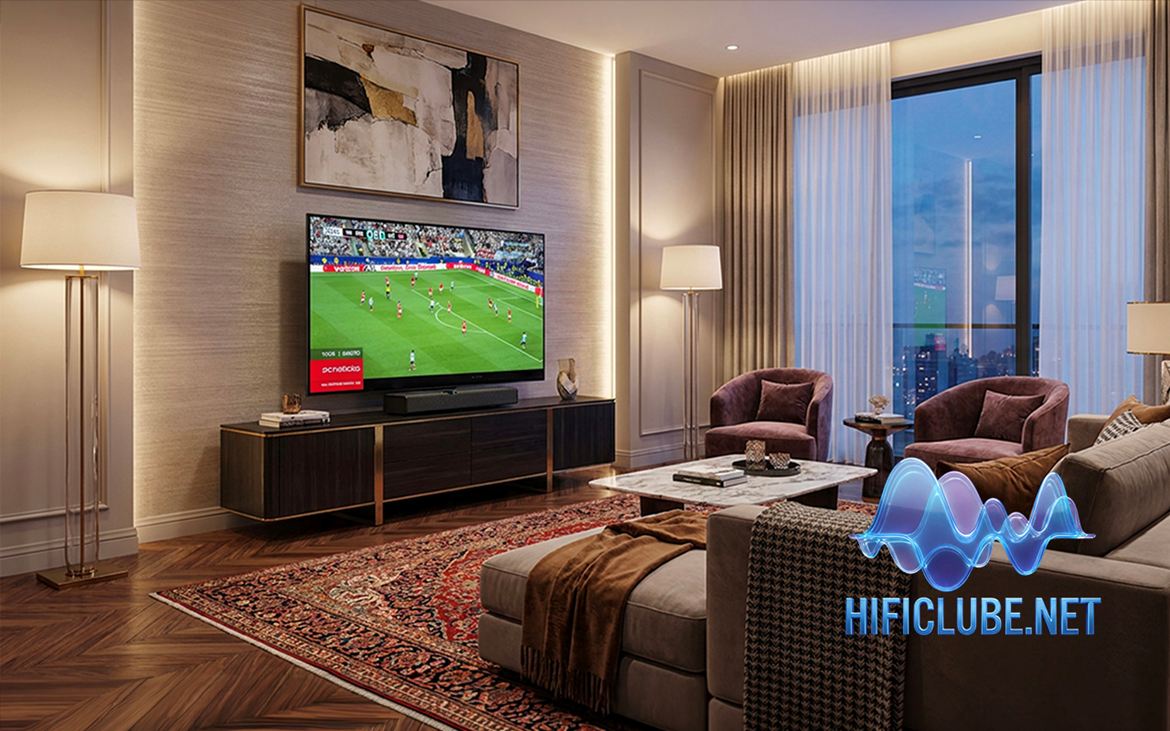
The VEGA is a one-piece music system. It is not a soundbar — something I learned the hard way when I set it up on a table beneath my TV. It didn't work very well there, as the sound didn't seem to come from the screen.
Of course, it has HDMI ARC and plays sound from news programmes, films and concerts. But that isn't what it was designed for, as DALI is keen to emphasise: there is no Dolby Atmos, nor upward-firing drivers — only rear-firing ones.
It does, however, have plenty of other drivers:
- At the front: two 25 mm soft-dome tweeters with low-viscosity ferrofluid and a rear chamber; and two 4.5-inch mid-bass drivers with paper-fibre cones.
- At the rear, in acoustic symmetry, are two more tweeters and two mid-bass drivers.
- At the ends sit two 3×6-inch rectangular passive radiators. Everything was developed in-house — speakers, amplification and the DSP platform — all designed by DALI's engineering team.
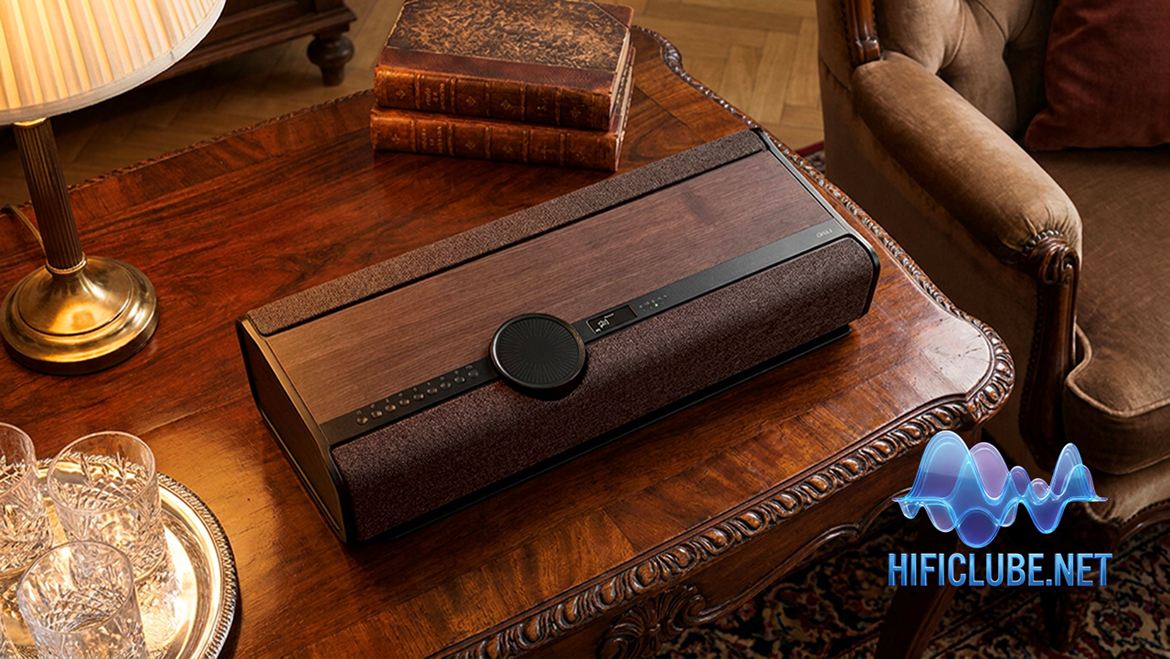
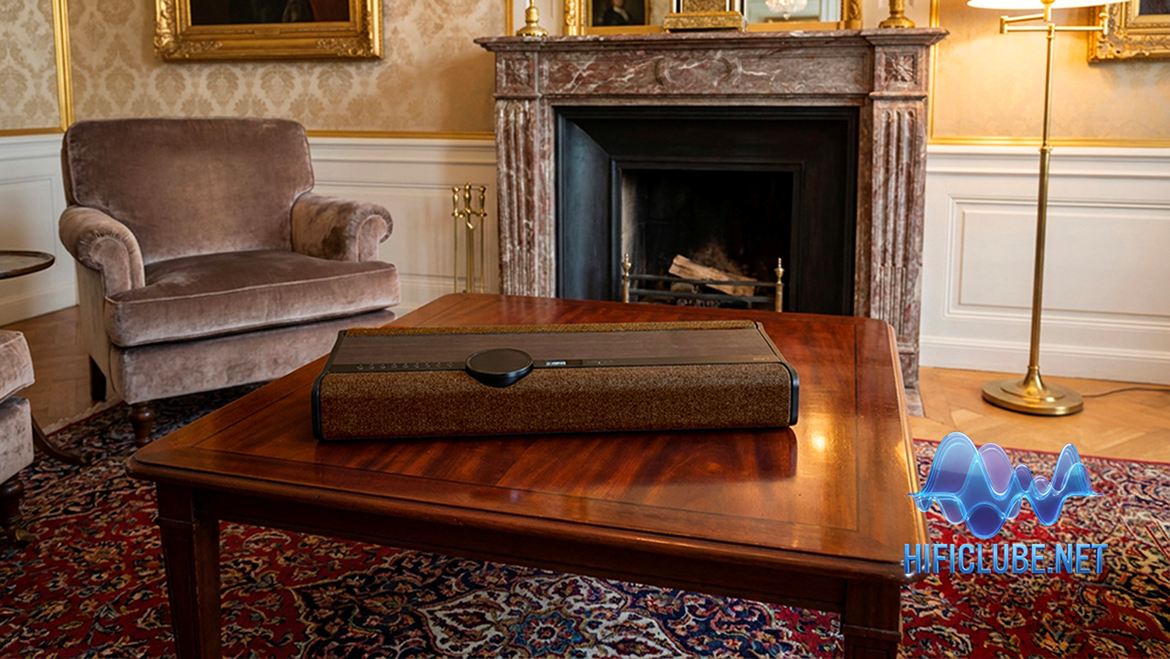
This electronic core is housed in a wooden cabinet with a natural oak finish (Dark Oak and Natural Oak), metal ends and a genuine fabric wrap. It measures 683 mm wide, 143 mm high and 243 mm deep, and weighs just 8.7 kg. It can be placed on a dresser or bookshelf, mounted horizontally on a wall, or hung vertically. The choice is yours.
Inside, there is 400 W of Class D power, distributed evenly across eight 50 W channels. The specified frequency response is 32 Hz to 22.7 kHz (±3 dB), with a maximum SPL of 110 dB at one metre. The crossover frequency is set at 2,400 Hz, with a DSP-controlled 2-way active crossover.
Music Centre
Now, these are serious speaker specs by any measure. The VEGA is therefore not just a piece of Danish-styled furniture. It is a modern music centre that integrates a DSP platform with BluOS streaming management and all that comes with it:
- On the wireless front, the VEGA runs BluOS — the Lenbrook platform we already know from Bluesound, NAD and others.
- It supports Tidal Connect, Qobuz, Spotify Connect, TuneIn, Radio Paradise, MQA, AirPlay 2, and Bluetooth with AAC, aptX and aptX HD.
- Physical inputs: HDMI ARC, analogue stereo RCA, optical digital, USB for external storage, and Ethernet.
- Outputs: subwoofer (with a 120 Hz low-pass filter) and 5 V/1 A USB.
- There are also five programmable buttons.
It lacks a USB-B port for connecting to a PC, and the sub output isn't dual. But who could ask for more at only €2,999?
For €3,000, you could buy a system of separate components and a good pair of DALI speakers. But then you'd lose that understated Danish bourgeois charm…
The obvious comparison is with the Naim Mu-so 2, but the VEGA has a different soul: it's more understated, more Danish, has less bass show-off, and — how shall I put it—more musical. There you go, especially if you explore the DSP features:
- Adaptive Stereo Enhancement (ASE)
- It analyses the incoming stereo signal in real time and adapts it to create a wider stereo image from a single speaker.
- Adaptive Orientation Adjustment
- A sensor detects whether the speaker is lying down, standing upright, mounted on a wall. And there are three placement modes that adjust the rear-array output to the location: open space, near a wall, or tucked into a corner.
And then there is that delightful detail: the small circular OLED display rotates to match the speaker's orientation. Stand it upright, and the display rotates to match. Lay it down, and the display rotates again. It's nothing we don't already have on our mobile phones, but DALI has clearly tried to appeal to younger audiences too.
Before we move on to the listening session and its nuances, a few preliminary comments. The display could be larger, as it is hard to read from a distance. The BluOS app solves that issue, of course. In free-space mode, the rear speaker array tends to be more audible, and the front sound loses focus.
Auditions
Brian Eno — "An Ending (Ascent)" (Apollo: Atmospheres and Soundtracks)
The entire track paints a landscape: a synthesiser whose sound expands and contracts, gliding without urgency or a fixed image. Indeed, the whole album was composed to be "ignored" by the listener — it embodies the true concept of ambient music.
What the VEGA does here is remarkable precisely because it is imperceptible: the ASE doesn't try to pin the sound to a specific spot; it spreads it throughout the entire room. Anyone walking from the living room to the kitchen is caught in the music's spell. The deep bass that underpins the harmony is discreet and almost subliminal — the kind of thing that, in a conventional system, fades the moment we move two metres from the sweet spot; here, it follows the listener like a dog following its owner. Everywhere.
You can cook (and eat) a light meal with this sound in the background, even stopping in the middle of the room to answer the phone. What is lost in the soundstage geometry is gained in space and freedom.
Nils Frahm — 'Says' (Spaces)
'Says' also opens with a synthesiser pulse that builds in layers until it reaches a tribal cadence, with a long reverb tail, supported by electronic percussion textures that would never fit a classic stereo image.
You can cook (and eat) a light meal with this sound in the background, even stopping in the middle of the room to answer the phone. What is lost in the soundstage geometry is gained in space and freedom.
Arvo Pärt — Tranquility Violoncello. 'Spiegel im Spiegel'
Here we have a harmonic love triangle: piano, cello and… silence, which is also sound. In a conventional system, the piano sits on the left, the strings on the right, and the listener gazes at the image as if it were a holographic painting.
On the VEGA, the sound sources seem to dissolve into the vague resonance that fills the space between the notes. The piano is there, and so is the cello. Yet the music seems to float in the air.
So if someone walks into the room, they don't interrupt the listening experience, because they don't cut our physical connection to the sound. And that person is also enveloped by the music without disturbing it — or us.
What happens with VEGA stays with VEGA…
General Listening Impressions
The VEGA reproduces high-quality ambient music. If you're one of those audiophiles who sits in the "sweet spot" and doesn't move a muscle for fear of losing focus — because you take pleasure in the reproduction of a stable, geometrically defined "soundstage" — the VEGA isn't for you.
If your thing is listening to music all over the room while walking back and forth, without worrying about achieving a "stereophonic image" in the orthodox audiophile tradition, the VEGA is your ideal companion.
I think that is exactly what defines it: VEGA doesn't force the listener to actively participate in the act of listening, sitting motionless in a chair; it gives you freedom of movement while selecting the best music for you. It isn't a music centre — let's call it that — for die-hard audiophiles.
Marital Bliss
I belong to an old school that always prefers separate components for listening to music, especially speakers. But if I were young and living in a studio flat with a wife who has strong aesthetic tastes, I think the VEGA would add to our “Marital Bliss” every day of the year: at home, what happens with VEGA stays with VEGA…
You are going to love it. So will your wife. The only problem now will be justifying those huge speakers in the living room. Do you really need them?
DALI didn't invent this category, but it has treated it with dignity and style. Recommended.
For further information, please contact: